Green tea, Lipton, licorice tea, we drink it all day long here. It reminds me of when I spent the holiday season in England. It’s great. I start my day with chai and breakfast, then I get to the office and we have more chai. Mmm if we’re not having chai we’re having delicious fresh squeezed juice. My favorite is the same as in Morocco, “kele ka juice” a.k.a. banana juice. Well I guess au Maroc I had two favs, banana and avocado, but you can’t get avocados here so I’m happy with my kele ka juice. They also make a lot of vegetable juices here, and those are growing on me cause I know they’re healthy!
Anyway, we have lunch followed by more chai, and then a few hours later another juice or another chai. There’s even a 30 minute tea break scheduled into my class with the Turkish guys. They like drinking tea, but not the Pakistani way. They take it black, whereas the Pakistanis take it with hot milk and sugar.
Time for my post dinner chai and biscuits….
Thursday, February 09, 2006

Monday, February 06, 2006
Foothills of the Himalayas
If you know me you know that I love enjoying God’s creation, whether that be kayaking on a lake in the morning mist or trekking through small villages amidst snow covered peaks. Before Duiii left we took a few days to head out of the city and into the hills: the foothills of the Himalayas. Because it’s winter and many places further north are inaccessible due to the snow and road damage caused by the earthquake, we just headed to Pindi (next to Islamabad) and then took a taxi up to Murree. Murree is a resort town created by the British to escape the summer heat of the cities.
Murree was nice and somewhat scenic, but crowded with tourists. Not western tourists, but Pakistanis from the city who wanted to catch a glimpse of the baraf (snow) that comes at 2000m elevation. Since we were the only white people there, it was quite frustrating to walk around constantly stalked by the staring eyes of the “hip” boys from the city. We enjoyed walking around Murree, but the Himalayan peaks we could see from the roadside were beckoning. Everything inside of me just wanted to be OUT of Murree and instead to be surrounded on all sides by rivers, snow, villages, and away from the tourist kitsch of a touristy resort town exploiting nature. The litter, the badly kept lame horses on offer for rides and photos, and the constant staring were really getting to me. I was praying for a Philip style supernatural transportation to another place where there would be unspoilt nature and a place where I didn’t have to constantly be on the move in order to avoid taxiwalas, coffeewalas (wala means seller or do-er), any every other kind of wala.
We just ended up going back to the hotel on our second day there, and Duiii went out later to grab some food for dinner. He said it was just so much more enjoyable to walk around by himself because a foreign guy attracts much less attention than a foreign guy with a foreign girl. The next morning we left for the nearby town of Bhurban in the hope that it would be less touristy and crowded than Murree. As we walked away from the tourist section of town I started to feel the shalom coming over me. In order to get to the general bus stand we had to walk through the residential part of Murree, which was much nicer and more calm than the resort section. We stopped to ask directions and a nice old man showed me the way to find the buses and taxis that the locals used. All the way we were passing taxiwalas trying to make us deals and make us go to cities we didn’t even plan to go to. On the way to the bus stand we passed by some stands selling spicy samosas and other fried Pakistani goodies. I stopped to buy some fried aloo (potatoes) and 2 samosas (spicy fried snack filled with potatoes). 13 rupees for all that, and it’s 60 rupees to a US dollar. Do the math, that’s a cheap snack!
The bus station was bustling with people, and contained all the craziness and chaos I had expected. This kind of traveling is the exciting kind. J We jumped into a tiny Suzuki pickup with covered sides and benches in the back to wait for the vehicle to fill up and head to our first stop, Sunny Bank. 5 rupees each for a 15 minute ride. Since I’m a woman I got to sit all the way on the inside. Any other women who wanted to jump in also sat all the way on the inside, and a son, husband, or small child would serve as the buffer between the women and the men. The men from the village were so much more respectful than the tourists from the city. It was amazing! The men would squish together just so none of them had to sit across from me. They avoided looking at me or making eye contact at all costs. It was funny though because they would try to talk to Duiii and end up talking to me anyway since he doesn’t understand much Urdu. Honestly though, I felt safer and more comfortable crammed into the back of that Suzuki driving along windy mountain roads than I had walking around in downtown Murree. They fit so many people in the Suzikis that the young men were just hanging off the back as we climbed in elevation. I was thinking, “I wish I wasn’t a girl so I could hang off the back and get a better view!”
We caught a second Suzuki from Sunny Bank to Bhurban and were dropped off at a random spot on the side of the road. We knew we’d made a good decision to get out of Murree because we were able to sit down and drink some tea with a nice view of the mountains….and there weren’t throngs of people around! It was so peaceful and calm. Al-humdullah! We were wondering why we hadn’t just bypassed Murree in the first place.
We followed some signs up the road which pointed towards the PC Bhurban (Pearl Continental, fancy chain of hotels) and the youth hostel. Trudging through red Himalayan clay, we took a detour to admire the scenery and the mountain villages dotting the mountains around us. When we finally reached the youth hostel, we realized that it was closed and even if it was open only members of the Pakistani Youth Hostel Association are allowed to stay there. To get into the gate of the PC Bhurban cost 200 rupees a head, and it was over 7,000 rupees a night to stay there so that was out of the question. I think we were down to 1,400 rupees total and there aren’t any ATMs til Pindi. Most hotels here were closed for the winter, but one man from the village started trying to help us find a room. I was having trouble understanding most people since they weren’t speaking Urdu. We were shown one fancy hotel that we couldn’t afford even after bargaining and finally found a simple hotel underneath a restaurant. I think were the only tourists in Bhurban not staying at the PC hotel.
We wandered around the famous Bhurban golf course (nobody was golfing) and then starting walking towards the next village. This cute little old man who works as a guide for the PC hotel started walking with us and giving us a tour. I was afraid he’d make us pay for his services, but he insisted that he was just walking home. He kept wanting to take pictures of us (I think he just liked the digital camera) and we let him cause he was so old we knew we could outrun him if he tried to make away with the camera. His Urdu was very clear and I could understand everything he was telling us, so it was quite a nice walk although he kept making us stop for pictures in not-so-scenic locations. Finally I took the camera and took a picture of him with Duiii, and we tried to convince him that we didn’t need a thousand pictures of us with trees in the background.
Murree was nice and somewhat scenic, but crowded with tourists. Not western tourists, but Pakistanis from the city who wanted to catch a glimpse of the baraf (snow) that comes at 2000m elevation. Since we were the only white people there, it was quite frustrating to walk around constantly stalked by the staring eyes of the “hip” boys from the city. We enjoyed walking around Murree, but the Himalayan peaks we could see from the roadside were beckoning. Everything inside of me just wanted to be OUT of Murree and instead to be surrounded on all sides by rivers, snow, villages, and away from the tourist kitsch of a touristy resort town exploiting nature. The litter, the badly kept lame horses on offer for rides and photos, and the constant staring were really getting to me. I was praying for a Philip style supernatural transportation to another place where there would be unspoilt nature and a place where I didn’t have to constantly be on the move in order to avoid taxiwalas, coffeewalas (wala means seller or do-er), any every other kind of wala.
We just ended up going back to the hotel on our second day there, and Duiii went out later to grab some food for dinner. He said it was just so much more enjoyable to walk around by himself because a foreign guy attracts much less attention than a foreign guy with a foreign girl. The next morning we left for the nearby town of Bhurban in the hope that it would be less touristy and crowded than Murree. As we walked away from the tourist section of town I started to feel the shalom coming over me. In order to get to the general bus stand we had to walk through the residential part of Murree, which was much nicer and more calm than the resort section. We stopped to ask directions and a nice old man showed me the way to find the buses and taxis that the locals used. All the way we were passing taxiwalas trying to make us deals and make us go to cities we didn’t even plan to go to. On the way to the bus stand we passed by some stands selling spicy samosas and other fried Pakistani goodies. I stopped to buy some fried aloo (potatoes) and 2 samosas (spicy fried snack filled with potatoes). 13 rupees for all that, and it’s 60 rupees to a US dollar. Do the math, that’s a cheap snack!
The bus station was bustling with people, and contained all the craziness and chaos I had expected. This kind of traveling is the exciting kind. J We jumped into a tiny Suzuki pickup with covered sides and benches in the back to wait for the vehicle to fill up and head to our first stop, Sunny Bank. 5 rupees each for a 15 minute ride. Since I’m a woman I got to sit all the way on the inside. Any other women who wanted to jump in also sat all the way on the inside, and a son, husband, or small child would serve as the buffer between the women and the men. The men from the village were so much more respectful than the tourists from the city. It was amazing! The men would squish together just so none of them had to sit across from me. They avoided looking at me or making eye contact at all costs. It was funny though because they would try to talk to Duiii and end up talking to me anyway since he doesn’t understand much Urdu. Honestly though, I felt safer and more comfortable crammed into the back of that Suzuki driving along windy mountain roads than I had walking around in downtown Murree. They fit so many people in the Suzikis that the young men were just hanging off the back as we climbed in elevation. I was thinking, “I wish I wasn’t a girl so I could hang off the back and get a better view!”
We caught a second Suzuki from Sunny Bank to Bhurban and were dropped off at a random spot on the side of the road. We knew we’d made a good decision to get out of Murree because we were able to sit down and drink some tea with a nice view of the mountains….and there weren’t throngs of people around! It was so peaceful and calm. Al-humdullah! We were wondering why we hadn’t just bypassed Murree in the first place.
We followed some signs up the road which pointed towards the PC Bhurban (Pearl Continental, fancy chain of hotels) and the youth hostel. Trudging through red Himalayan clay, we took a detour to admire the scenery and the mountain villages dotting the mountains around us. When we finally reached the youth hostel, we realized that it was closed and even if it was open only members of the Pakistani Youth Hostel Association are allowed to stay there. To get into the gate of the PC Bhurban cost 200 rupees a head, and it was over 7,000 rupees a night to stay there so that was out of the question. I think we were down to 1,400 rupees total and there aren’t any ATMs til Pindi. Most hotels here were closed for the winter, but one man from the village started trying to help us find a room. I was having trouble understanding most people since they weren’t speaking Urdu. We were shown one fancy hotel that we couldn’t afford even after bargaining and finally found a simple hotel underneath a restaurant. I think were the only tourists in Bhurban not staying at the PC hotel.
We wandered around the famous Bhurban golf course (nobody was golfing) and then starting walking towards the next village. This cute little old man who works as a guide for the PC hotel started walking with us and giving us a tour. I was afraid he’d make us pay for his services, but he insisted that he was just walking home. He kept wanting to take pictures of us (I think he just liked the digital camera) and we let him cause he was so old we knew we could outrun him if he tried to make away with the camera. His Urdu was very clear and I could understand everything he was telling us, so it was quite a nice walk although he kept making us stop for pictures in not-so-scenic locations. Finally I took the camera and took a picture of him with Duiii, and we tried to convince him that we didn’t need a thousand pictures of us with trees in the background.
Saturday, February 04, 2006

Badshahi Masjid
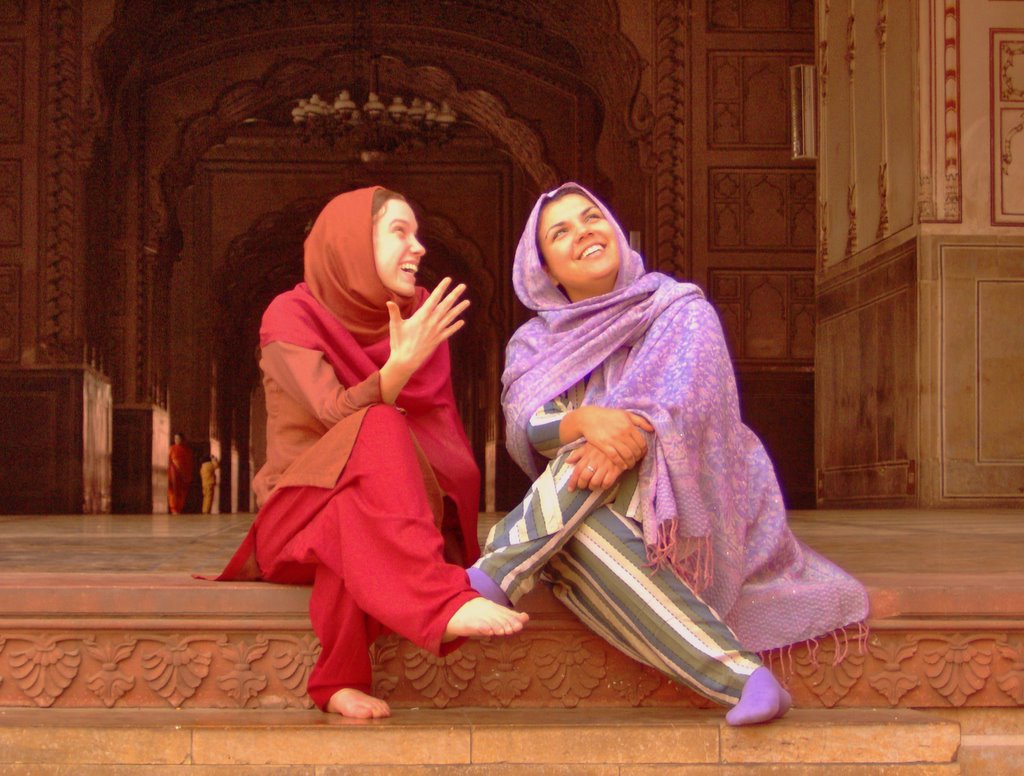
Anita and I chatting at Badshahi Mosque - like my shalwar-kameez?
More photos from Lahore - 4 new albums
Maf karo
It’s what you are supposed to say to beggars when they crowd around you asking for money. Many have visible deformities. Missing limbs. Stump arms and legs. Hare lips. Maf karo. They crowd around the car putting their fingers to their lips. Asking for food. Telling you they have four children at home and not enough money to eat. Maf karo. Women cradling their children who stare at you through dark sullen eyes. Young boys and girls with tattered filthy clothes. Maf karo – go away and leave me alone.
Outside Iqbal’s tomb the other day three young girls crowded around us asking for money. They sit outside the tomb all day long, hoping that those who come to make pilgrimage or visit the great Badshahi mosque will feel convicted and give them some zakat (alms for the poor). Directly next to the mosque, which can fit bout 10,000 worshippers, is Lahore’s red light district. These teenage girls were more than likely to be some of the ‘dancing girls’ which this quarter is famous for. Prostitution is illegal in Pakistan, but dancing is classified under the performing arts, so if the prostitutes go by this other profession it’s perfectly legal. What happens after the dancing is not to be talked about, but everybody knows. We tell them “Maf karo,” and when they start pressing up against us it’s “Mai police ko bulaunga.” I’ll call the police.
Begging is a huge part of the economy here in Pakistan. There aren’t enough police to round them up, and even if they do the beggars are let out in a few days and go back to their profession. For many of them it is like a career. Anita told me a story about her cousin encountering a beggar. Her cousin was coming home from work when he saw a beggar on a street corner. They tend to position themselves at all busy intersections in order to take advantage of the traffic. Her cousin reached into his pocket to give him all the change he had, and accidentally gave him a loose diamond he had just bought. When the cousin returned home at night he realized that the diamond was missing and that he must have given it to the beggar on the street. In the hopes that the man would give it back, he set out the next day to the same street corner to find him. When he arrived there was another man begging, and so the cousin asked where the man from the previous day had gone. He was informed that it was “his day off” and he was at home. Beggars are highly organized here. They rotate who goes where and even take a proper Sabbath. They all work together as if they were a union.
So the cousin gets directions and goes to where the beggar lives. It’s a house with a car, servants and everything. He starts to wonder if this could really be the house, and feels ridiculous coming to ask about the diamond. How could a man begging on the streets have so much wealth? The cousin goes inside and sees the man, same face, dressed in proper clothes and sitting on a couch. The beggar beckons the cousin to come in and asks how he can help. The cousin tells him that he accidentally gave him something the day before which he needs and the beggar asks his servant to bring him what he had collected the day prior. The servant brings a little bag tied up with all the earnings from the previous day, and sure enough the diamond was inside. Her cousin took the diamond, thanked the man, and went on his way.
Anita assured me that not all beggars live such a life as this one, but that this was a huge shock for her family to find out. It really is a big part of the economy over here, and not be encouraged. There truly are many beggars who need to ask for money in order to eat and who sleep on the streets, but there are SO many it’s overwhelming. Maf karo. What are we to do when we look into their eyes? Giving change or money doesn’t seem to be the answer, as even the young children are likely to use it to satisfy their drug habits. But there is a greater hope found in holistic ministry, if only there were laborers for this harvest. Maf karo.
Outside Iqbal’s tomb the other day three young girls crowded around us asking for money. They sit outside the tomb all day long, hoping that those who come to make pilgrimage or visit the great Badshahi mosque will feel convicted and give them some zakat (alms for the poor). Directly next to the mosque, which can fit bout 10,000 worshippers, is Lahore’s red light district. These teenage girls were more than likely to be some of the ‘dancing girls’ which this quarter is famous for. Prostitution is illegal in Pakistan, but dancing is classified under the performing arts, so if the prostitutes go by this other profession it’s perfectly legal. What happens after the dancing is not to be talked about, but everybody knows. We tell them “Maf karo,” and when they start pressing up against us it’s “Mai police ko bulaunga.” I’ll call the police.
Begging is a huge part of the economy here in Pakistan. There aren’t enough police to round them up, and even if they do the beggars are let out in a few days and go back to their profession. For many of them it is like a career. Anita told me a story about her cousin encountering a beggar. Her cousin was coming home from work when he saw a beggar on a street corner. They tend to position themselves at all busy intersections in order to take advantage of the traffic. Her cousin reached into his pocket to give him all the change he had, and accidentally gave him a loose diamond he had just bought. When the cousin returned home at night he realized that the diamond was missing and that he must have given it to the beggar on the street. In the hopes that the man would give it back, he set out the next day to the same street corner to find him. When he arrived there was another man begging, and so the cousin asked where the man from the previous day had gone. He was informed that it was “his day off” and he was at home. Beggars are highly organized here. They rotate who goes where and even take a proper Sabbath. They all work together as if they were a union.
So the cousin gets directions and goes to where the beggar lives. It’s a house with a car, servants and everything. He starts to wonder if this could really be the house, and feels ridiculous coming to ask about the diamond. How could a man begging on the streets have so much wealth? The cousin goes inside and sees the man, same face, dressed in proper clothes and sitting on a couch. The beggar beckons the cousin to come in and asks how he can help. The cousin tells him that he accidentally gave him something the day before which he needs and the beggar asks his servant to bring him what he had collected the day prior. The servant brings a little bag tied up with all the earnings from the previous day, and sure enough the diamond was inside. Her cousin took the diamond, thanked the man, and went on his way.
Anita assured me that not all beggars live such a life as this one, but that this was a huge shock for her family to find out. It really is a big part of the economy over here, and not be encouraged. There truly are many beggars who need to ask for money in order to eat and who sleep on the streets, but there are SO many it’s overwhelming. Maf karo. What are we to do when we look into their eyes? Giving change or money doesn’t seem to be the answer, as even the young children are likely to use it to satisfy their drug habits. But there is a greater hope found in holistic ministry, if only there were laborers for this harvest. Maf karo.
Subscribe to:
Posts (Atom)


 Posts
Posts

